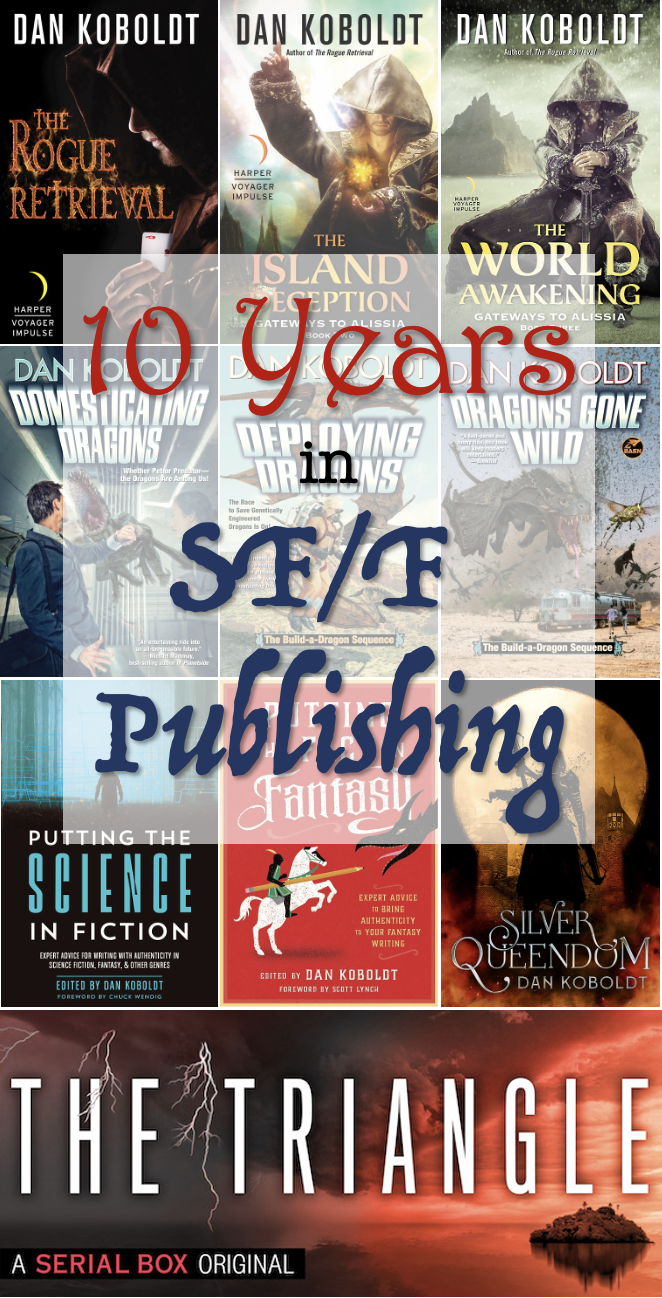
 Ten years ago, my debut novel was published by Harper Voyager Impulse, an imprint of Harper Collins. It was not the beginning. There are no beginnings or endings when you become part of the SF/F publishing industry. But it was a beginning.1 The journey to that point was not easy or short, but I’ve told the “How I broke in” story many times. As have most authors. Instead, I thought I’d share highlights of what happened after my first book came out: the highs and lows of a decade in SF/F publishing.
The Query Trenches and The Pitch Wars
Sometime in the 20-teens I joined the world of author pitching contests, the most famous being Pitch Wars. This was an annual event founded by Brenda Drake aimed at helping authors with complete, query-ready manuscripts find a literary agent. Brenda and I had met a few years before this time while I was in the query trenches. I was very lucky because I’d finished one book, queried it, and managed to find a literary agent. That alone was a huge accomplishment. Because of that, and because Brenda and I were friends, I shoe-horned my way into becoming a Pitch Wars mentor for adult SF/F. It ended up being a fair amount of work to read 50-75 query letters and first chapters from aspiring authors each year, and to give one of them a full manuscript critique. The experience certainly made me appreciate what literary agents do.
 But hey, I’ll be honest: being a PW mentor was fun. Especially when I teamed up with my friend Mike Mammay. He was a PW success story himself, and an outstanding mentor for aspiring SF/F authors. We got to read a lot of queries and first chapters. So many of them were really good; it was often hard to choose just one. This was around the time that the contest really took off, when the showcase was a feeding frenzy for literary agencies and agents were flying to other cities to sign authors in person. Not in adult SF/F, of course — we always had a conversation with mentees about keeping realistic expectations.
A key element of PW was that all of the mentors were volunteers. Many of us had only recent found an agent ourselves, putting us only a couple of steps ahead of our mentees. We remembered what it was like to be in the query trenches, and PW was our way of giving back. I made many, many friends among the mentors, mostly through our lively Facebook group. We formed a sort of collective, supporting one another through the highs, lows, and unexpected dramatics of publishing. Each year’s mentee class formed similar bonds. It illustrated lesson one: find an author support group. They don’t have to live in the same area or write the same genre, but they should be at a similar stage if possible. Then, you can lift each other up at each new rung of success.
A New Author and an Old Fool
In January 2016, my first novel, The Rogue Retrieval — about a Vegas magician who poses as a real wizard in a secret medieval world — came into the world. 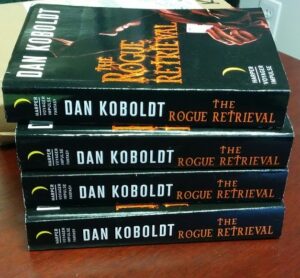 January in the midwest is the dead of winter. Not necessarily the best time to promote something, but I got to live that dream. Hold my book in my hand, launch it with family and friends, all of the things.
To exactly no one’s surprise, I was feeling ambitious — figuring that if the book did well and I got some other things published, I might have a shot at making the shortlist for the Campbell award.2 I had an agent, a publisher, and an option clause that allowed (required) me to send my next work of adult to SF/F to my editor before shopping it elsewhere. I’d already written a book and had it ready, along with a proposal for a third to make it a trilogy. I also had a wish-list of things that I hoped I might get with a second book, assuming the publisher wanted one.
Unfortunately, it was around this time that I had a falling out with my literary agent and we parted ways. That was a dark day. The only silver lining was my relationship with my editor at Harper Voyager. They seemed to like me, and when I sent him my next book and proposal for a third one, he said, let’s do both. These would be Voyager Impulse titles like my first book, so there was no handsome advance attached. Even so, it put me in a position to search for a new agent. This brings to lesson two: build bridges along your author road. Make friends. Network. Do favors for people. You’ll never know when those relationships can help you, as my story is about to show.
The Paul Era of Productivity
A friend I’d made through PW heard I was agent-shopping and introduced me to Paul Stevens, who’d left his job as a longtime editor at Tor and had quietly begun taking on clients at DMLA.3
Paul and I worked well together. He advised me while I finished the two more books for Voyager Impulse. The books did okay. Impulse was an experimental, digital-first imprint that published a lot of authors in a relatively short time. In some ways, it was like playing junior varsity to the varsity team. With no advances, no audio, and no real print distribution, our books were not in the same class as those of traditional Voyager authors (varsity). Even so, the experience was beneficial. I learned how to work with editors and publishing staff, reach out to bookstores, and engage readers. Because HVI published many authors in a short period — and we all had similar experiences — we formed a collective. We supported each other and became friends, come what may. The learning experience and that supportive group were invaluable.
The HVI-versus-Voyager experience highlights a hard truth about the publishing industry. Lesson three: the goal posts for authors are always moving. Every time you reach one, there’s no time to celebrate because now there’s another objective in view. It’s almost like leveling up in a never-ending role playing game. You got an agent, level up! Now get a book deal. You sold a book, level up! Now make sure it earns out and that you establish a track record of sales so that you can sell subrights and maybe next time get a bigger advance and/or more marketing support. Layered on top of this is the perception that every other author in the world is lapping you on the race track. Because that’s a side effect of getting published — you meet, befriend, and inevitably keep tabs on lots of other authors.
Science and Fiction
Because I was younger and well-caffeinated, I had other irons in the fire. I was working on other books, of course, but I’d also started a weekly blog series in which I invited people who were legitimate subject matter experts to share advice with SF/F authors. The Science in Sci-Fi, Fact in Fantasy series. I wrote the first few posts myself, expounding on common misconceptions about genetics and heredity [4].
It seemed to useful to provide authors with practical advice on a topic that features in many SF/F stories. There were lots of other topics, though — physics, engineering, chemistry, aeronautics — in which I wasn’t an expert. But it turns out that there were a lot of experts around. Many of them were writers themselves, and all of them — like me — enjoy talking about their work. Fast forward to World Fantasy 2016, which was held in Columbus. I’d just moved here and didn’t know many people, but Paul came for the con and took me out to dinner. That’s where he asked if I thought about turning the blog series into a nonfiction book.
 Unlike novels, nonfiction books are generally sold on proposal. Neither Paul nor I had done one before. He did not know many editors for this type of book, so there was research to do. We got to work on the format, and on things like finding editors who acquired nonfiction. There was, of course, one natural place that published books, magazines, and other things for authors. Writer’s Digest. They published many well-known books like The Breakout Novel by Donald Maass and Damn Fine Story by Chuck Wendig. Visit that shelf in the reference section of any bookstore, and WD is the most prolific publisher by far.
When they showed interest in our nonfiction proposal, I almost couldn’t believe my luck. The editors and I even had a strategy call before the acquisitions meeting — the only time I’ve gotten to do that — and I really enjoyed being part of the process. They made the offer, and we started figuring out how to compile blog articles into a book. The whole thing felt like a dream.
When Chuck Wendig agreed to write the foreword, I was sure it was a dream. The book came out in October 2018 and Writer’s Digest even arranged for me to attend NYCC and do a science fiction panel with Chuck himself. He was attending the con anyway because he was writing Star Wars for Del Rey.
That was a pinnacle of my author career. Going to New York City and doing a panel and book signing with Chuck Wendig. I’d been a religious follower of his blog for years, so it was a thrill to meet him in person. Great guy, smart but incredibly humble, and funny as hell. If you read his blog you know — he’s just like it. And let me tell you, that dude has a fan base. Our panel at NYCC had a line to get in. The room was packed. Afterward, thirty or forty people lined up to get a copy of PSIF signed by us.5 It was undoubtedly my fifteen seconds of fame, completely on someone else’s coattails. When my moment was over, I simply enjoyed my first Comic Con. I got to meet some author friends and industry people in person. I saw some celebrities from a distance. And I was reminded of the sheer size of SF/F fandom. Lesson four: SF/F fandom is huge, but books are only a small corner of it. Exhibit A below is one of the few photos I took at NYCC, since I spent most of that week feeling overwhelmed:
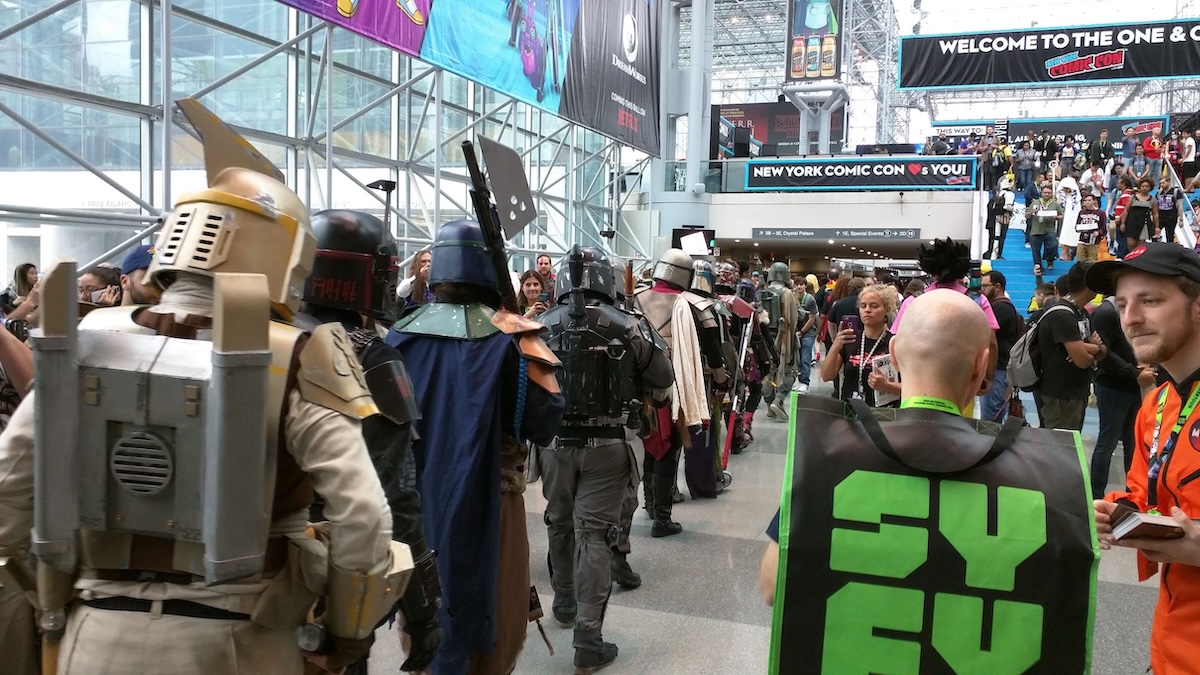
A parade of Boba Fetts at NYCC. I don’t know if this was planned or just happened, but it was awesome.
To Fantasy Facts and Baen Books
Even before PSIF came out, my blog contributors who were culture, historical, or other fantasy-subject-matter experts had begun asking about developing their side of the blog into a book. I admit, this seemed like shakier ground: I have real-world science credentials, but my experience on fantasy topics (archery, woodcraft) is more a side effect of my passion for bowhunting. Even so, my experts had a point and PSIF was going well, so we developed a proposal for it.
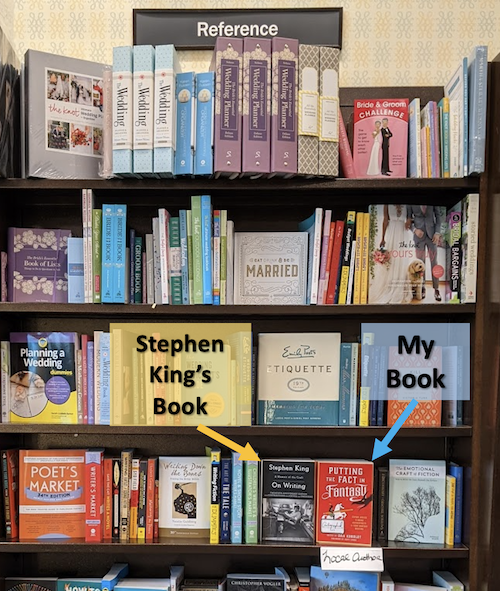
My book next to Stephen King’s. Not staged. B&N Polaris, I will always love you
In the interim, the parent company for Writer’s Digest had declared bankruptcy and its assets were sold off piecemeal. The magazine ended up with different owners than the book imprint. The only bright spot of good news? The book imprint’s new home was Penguin Random House. Somehow Paul and I cajoled them into publishing Putting the Fact in Fantasy, a book that I once found shelved next to On Writing by Stephen King (see the photo… yes, that made my day). The best part, of course, was another brush with fandom: I somehow persuaded Scott Lynch, one of my favorite modern fantasy authors, to write the foreword.
I kept writing fiction, too, and in particular was working on a book that combined two of my favorite things: genetics and dragons. Paul and I revised the book a few times. When it was ready to go out, one of the places we naturally wanted to shop it was Baen Books, a place with a stellar reputation for hard sci-fi. One thing I loved about working with Paul is that he treated me as an equal and allowed me to be part of the process. So when I said I happened to know an editor at Baen — Tony Daniel, for whom I’d written some nonfiction articles for their website (see “bridges” above) — he liked the idea of submitting to that editor.
It undoubtedly helped that Tony knew me and was aware of my career as a genetics researcher, so a book in which genetics featured prominently would probably be hard SF.7 Later he told me that the publisher had asked him to find a book to put on the schedule for the next year. He’d read a bunch, selected two or three for her to consider… and she liked mine. The only issue was that she didn’t like the ending, so Tony came back and said, “We’ll make you an offer if Dan is willing to change the ending.” To his credit, he was quite willing to chat with me on the phone about their concerns. We had that conversation, worked out a plan for a different ending, and within a couple of days, Baen made the offer. That was a great day for me. I still remember where I was, and who I was with, when Paul called me.
The thing about Baen is that they do things their own way and make no apology for it. Obviously they work with literary agents and agencies, but that does not really move the needle as far as deal points are concerned. Agents like to go back and forth with major publishers on contract language, but Baen is quick to say “This is the offer, take it or leave it.” It can be frustrating at times, but they know their business model and what they need to succeed.
Furthermore, though such intransigence might concern me with another publisher, but Baen Books is wonderfully supportive of their authors. They proactively do things, like organizing regional events and sending out regular newsletters touting new releases and author events, that most publishers simply don’t have time for. They’re responsive by e-mail and on our Discord. If you’re in a pinch, as a Baen author, you can call their office. I’ve done it. They actually knew who I was when I gave my name. Lesson five: If someone makes the time to speak to you on the phone, you’re important to them.
Fantasies, Real and Imaginary
I had another book project, a new epic fantasy I’d started writing in the middle 20-teens. We offered it first as an option book to Harper Voyager. The nice thing about option clauses is that they have time limits: once you provide the material (usually an outline and sample chapters), the publisher has a certain period in which to respond. This was around when HVI was winding down, so I think there was an unspoken understanding that their decision would either be a pass, or a promotion to varsity. I thought that I had a reasonable shot at getting promoted. When Paul checked in at around the option expiration time, my editor said “We are talking about it.” So there was a discussion, apparently, but it didn’t go my way. They passed.
This ended my contractual obligation and effectively my relationship with Harper Voyager. Looking back, almost every HVI author was cut (not promoted) on similar grounds, with concerns about “reaching a wider audience.” 8 It seems a little unfair, because no one knew the limitations of the Impulse imprint better than the publisher did. But it was fine. I learned that I was not a special snowflake, and I moved on. The upside was that I could focus my efforts on writing the entire book, which I did. When it was done and ready to be shopped widely, Paul and I had a discussion. I was writing books for Baen and that was going very well. We weren’t obligated to send it to them — in fact, we kind of felt that Baen might not be the right place for that style of epic fantasy — but it felt wrong not to let them look first. So we did. And Tony, to his credit, said he liked it but didn’t think it was right for Baen.
 So then Paul put it on submission. It was less of a harrowing experience this time, at least for me, psychologically. I had faith in the book and in Paul. This paid off, as he rather quickly sold the book to Angry Robot. I had the pleasure of speaking to another editor (actually the publisher) before the editorial board meeting. She said she read the book in one sitting. If I hadn’t already known about AR and the wonderful things they were doing, that would have sealed the deal right there. Talk about the right place for a modern fantasy, too. I knew Angry Robot well and had followed them for a while.
They bought the book, and soon after, DMLA sold the audio rights to Tantor. Both parties did a wonderful, wonderful job in producing the book [9]. I love working with them. I also love that I have a fantasy publisher, and a sci-fi publisher, and both of them are okay with the arrangement.
Plus, I found another tribe. I suspected that there might be a group of Angry Robot authors, so I asked a friend who had a book with them — someone I knew through Pitch Wars, incidentally — who confirmed that this was true and made an introduction. That group calls themselves The Tavern. They’re not all AR authors, but a group of friends who are mostly published authors, and we hit it off immediately. They met by video call twice a week! There’s no way in the world I could fit all that in, but I joined when I could. And I soon found out that many of them were going to Chicago Worldcon.
This was in 2022, when through a confluence of factors, I had three books published in the same year: Deploying Dragons, Silver Queendom, and Putting the Fact in Fantasy. Chicago is close and I really wanted to go. It was on my own dime, of course, but with three books to promote I figured I could justify it. I pulled up to the hotel in a cab, and immediately spotted a group of my Tavern friends. What a great way to land at a major convention. Then I walked inside, and found Mike Mammay in the bar (surprising no one). We immediately vowed to try to sell more books than each other during the author signing events.
There was a bittersweet part of 2022. Paul had seemed a little checked-out over most of the year. I sensed something was amiss, so I asked if we should chat before I headed to Chicago. He did, and gave me the news I was dreading: he was leaving the business. This was devastating news. I was one of his first clients, and we’d achieved a lot together. DMLA had other agents, of course, but I didn’t know any of them very well. So at WorldCon, even though I was very tired from finishing three books and didn’t have much in the holster to show anyone, I was able to do some networking. I met a couple of the other DMLA agents in person. Also, my friend Mike — who knew everything that was happening — made sure that I met some people from his agency, Jabberwocky.
 I also got invited to a very nice event for DMLA authors and agents who were at WorldCon. It was in walking distance, at a fancy outdoor establishment. I got to meet some other clients, and introduced myself to a couple of the other agents. Because the universe loves irony, my first literary agent — with whom I hadn’t spoken since our falling out — was there and ended up sitting next to me. It’s yet another reminder that publishing is a small world. I had to leave for a panel, but the event went on for a few hours so I was able to come back. I’m really glad I did, because something awesome happened. Elizabeth Bear, one of DMLA’s clients, attended the event. When I came back to the event, her spouse had joined her. I moseyed over to meet him, because his name is Scott Lynch. When I introduced myself, he shook my hand, smiled, and said, “I heard you were around.”
Doubling Down on What Worked
Three books in 2022. It was a thrilling time but took a lot out of me. Still, I wanted to maintain that momentum, and part of that meant figuring out my agent situation. My contract, technically, was with DMLA. This is typical — authors sign contracts with agencies, and those contracts usually survive the departure of an agent from that agency. Although I had laid some ground work, I hadn’t yet really connected with any of the agents at DMLA who specialized in my type of books. Not for lack of trying, either. So I reached and asked, politely, if the head of the agency might be willing to chat with me sometime.
That’s how I ended up on the phone with Donald Maass. See lesson five, above.
It was an awesome conversation. He knew who I was, and Paul had kept him apprised of my career as things progressed. The question I asked him, of course, was about what he thought I should do next. Having heard my long story, he offered some simple but useful advice. Lesson 6: Keep doing what’s working. As far as representation went, he generously said that he wanted me to stay with the agency, and even offered to take me on himself if it came to that. However, as we both recognized how busy the guy is, he wanted me to connect with one of his agents if at all possible.
I ended up pitching two more books to Baen, and the publisher generously made me an offer for one of them. Another dragon book. I’d only given them an outline, and as it would turn out, I didn’t really follow the outline much at all. But they offered just the same. Now, with an offer from Baen was the time for me to officially send some queries 10. I started with DMLA, but the agent I had in mind — and who I’d met in person at WorldCon — turned me down. It was disappointing, but there wasn’t anything I could do. Lucky for me, the other two agents on my shortlist were quick to ask for a call. One of them was Brady McReynolds from Jabberwocky, to whom I’d been introduced by Mike 11.
Brady and I hit it off right away. He had already read some of my work to get a feel for it. He said nice things about it, and he relayed several appealing things about Jabberwocky and the things they could do for my career. I really liked the other agent who offered as well. It’s not a normal thing for a midlist adult SFF author to get two offers of representation. It meant a lot to me. I signed with Brady and we got to work. He got in touch with my publisher at Baen who immediately set the usual tone of “we don’t change our terms just because there’s an agent involved.” And you know what? It was fine. We all wanted this thing to happen, we were all professionals, so we worked it out.
More Dragons and Beyond
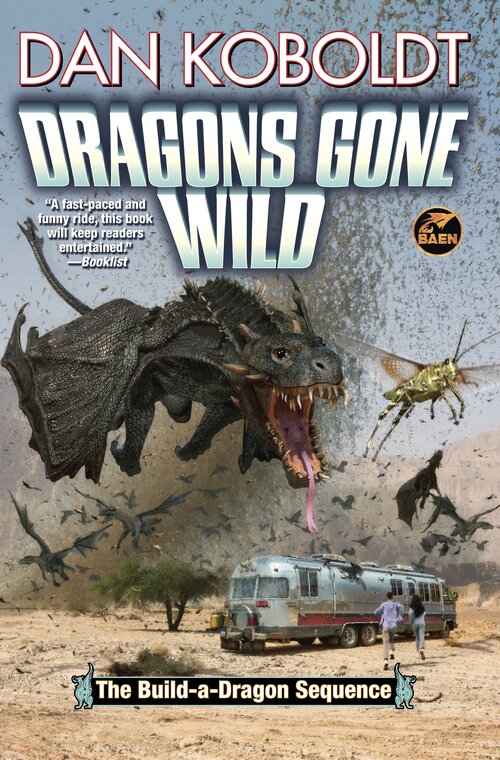 I’ve done three books with Baen, working with three different editors. My first two left the publisher shortly after working with me, and I try not to read too much about that. Privately I sent the publisher a note to say “I’m sorry they left and I hope it’s not me.” She just said “Me, too!” 12
In my third book with Baen, Dragons Gone Wild — is about releasing dragons into wilderness environments to curb specific ecological threats. It was a lot of fun to write, even though it seemed to take me forever. And I have a new editor, Griffin Barber, who I really like and who hopefully isn’t resigning as I write this. I have, by my count, nine books and a serial published so far. That works out to about one a year since I got into this game. Ten projects in ten years. I’m not done, either. At least, I think I’m not. I want to keep writing fantasy for Angry Robot and science fiction for Baen. Who knows, maybe there’s even another nonfiction book down the road.
Lesson 7: It’s hard, but still worth it. I can say that with some confidence, and here’s why. It’s no secret that my day job is in genetics. I work at a major children’s hospital that’s already emerging as a leader in genomic medicine. I’ve co-authored, no kidding, more than 150 research papers. That’s a pretty good career. And yet, when I travel to national meetings and see my colleagues in the field, they never seem to ask about my research or the grant I won or the latest paper. Almost all of them have the same question. So, are you writing another book?
SNARKY FOOTNOTES
[1] Yes, that’s an homage to the prologues of The Wheel of Time by Robert Jordan, easily one of my favorites.
[2] I was a sweet summer child, and did not realize that many SF/F awards, like many awards in general, are political in nature. Even if I had made the Campbell shortlist that year, I would have lost to Rebecca Roanhorse.
[3] Donald Maass Literary Agency. Yes, that Donald Maass.
[4] Don’t even get me started.
[5] By Chuck, that is. I could have easily been a chair or piece of furniture. No one would have really noticed.
[6] To my humility and unending delight
[7] This is a good example of how doing other things, like writing nonfiction for websites, can help an author down the road
[8] This is a polite way of saying “We don’t think this will sell enough copies.”
[9] Angry Robot’s print books are gorgeous. They surprised me, and even sprung for metallic silver lettering on the cover of Silver Queendom.
[10] The best time to query literary agents is when you have an offer from a traditional publisher. Mention that in the subject line, and you tend to get surprisingly fast responses.
[11] Yes, the world had come full circle. A guy I had (briefly) mentored got in with a top flight agency and later turned around to help open the door for me.
[12] In retrospect, that could be taken a couple of different ways.
Follow me and you'll never miss a post:


Please share this article:


Leave a Reply